Friday, February 23, 2018

How to Write a Book in 100 Days

Let’s start with the obvious: You don’t know how to write a book. I’ve written seven books, and I don’t really know how to write a book either. I have a process that works, sure, but with writing, as with many things in life, it’s always when you think you know what you’re doing that you get into trouble.

So let’s just admit right now, you don’t know how to write a book, and definitely not in 100 days, and that’s okay. There, don’t you feel better?
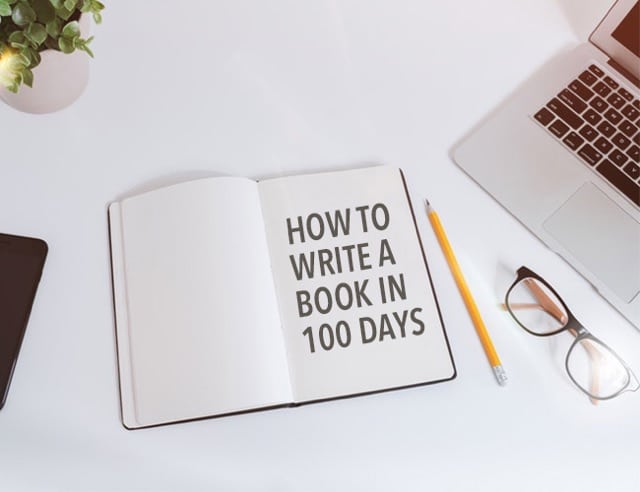
How to Write a Book in 100 Days.

There’s this one moment I think about all the time. I had just finished work—I had this horrible desk job at the time—and as I was getting ready to go home, I felt this urge come over me to become a writer. I had felt like I wanted to become a writer before, for years actually, but in that moment, it was all-consuming. Have you ever felt like that before?

And so, instead of going home, I got out a blank piece of paper, and I stared at it. I stared at that blank piece of paper for a really long time. Because I was looking for a book. If only I could come up with the perfect idea, if only I could write a book, then I’d finally feel like a writer.

But I couldn’t think of anything, or at least nothing worthy, and after staring at that blank piece of paper for an hour with nothing, I gave up. In that moment, I felt like I was further from my goal to become a writer than I ever had be. I was so discouraged.

I was discouraged because I didn’t know how to write a book.

Honestly, I might still be there today if I hadn’t had a few lucky breaks and several mentors to teach me the process of how to write a book.

Are you ready to finish your book in 100 days? Join the 100 Day Book program.

13 Writers Who Finished Their Books in 100 Days

You might say you’re not able write a book in 100 days. You might worry that you’re not able to write a book at all. But I don’t believe that. I honestly believe that everyone can write a book, and I’m not just saying that. I believe it because I’ve done it.

In fact I wrote my first book in fewer than 100 days. I wrote my latest book in just sixty-three days.

I’m not alone, either. I’ve worked with hundreds of other writers to write their books, too. Here are just a few:

Fall 2017 Cohort

These writers are just a few who finished their books in our Fall semester of the 100 Day Book program.

Stella Moreux had been “marinating” on an idea for her “southern fried” fantasy novel for more than three years, but it wasn’t until she signed up for the 100 Day Book program that she seriously started writing it. “I won’t mince words when I say this was hard,” Stella says in her post about the writing process. “However, I would not trade this experience for anything. I survived and finished! The 100 Day Book Program is a challenge but worth it!”

Jodi Elderton had written short stories, but never a novel, and with almost two jobs and young kids, she worried she never would. But she says, “This program made it doable, if you stick with it.” By the end, she finished her novel and said to her writing community, “We made it!” Read Jodi’s full story here.

Rita Harris had an incredibly hard year. After committing to writing her novel, she says she had a marriage breakdown, sold her house and moved, and then had a health scare. Any one of those things could have derailed her writing process, but she kept going, motivated by the writing team she had surrounded herself with and the accountability she agreed to. Despite everything, she finished her book, “something which I doubt I would have had even without the life challenges I faced during the course of my writing if I had not enrolled in the program.” Read her story of determination here.

Karin Weiss‘s novel, A Roaring Deep Within, had been languishing half-finished for years. When she began the process, she thought it would be easy, mostly rewriting, but the process proved much more difficult than expected. What saved her was the writing community in the 100 Day Book program. “I found there a ‘writer’s community,'” she says, “that was available night and day that gave me support and motivation to keep going when my energy dragged, or when I felt discouraged at a tough point in my writing.” Read more about how Karin finally finished her novel-in-progress here.

Spring 2017 Cohort

These writers are just a few who finished their books in our Spring semester of the 100 Day Book program.

Sef Churchill decided to write her book in 100 days “on an impulse one Thursday night.” She followed our process, and by Sunday had committed to an idea. How did it go? “Now I have a book,” she says, “a book which before that first Sunday, I had not even dreamed of.” Check out the 10 lessons she learned about the book writing process.

Ella J. Smyth wrote two of her Romance novels (two novels!) in a little over a 100 days. She talks about her experience, and the power of accountability, here.

Nathan Salley set aside one day a week to write his book, and in that restricted amount of time he was able to finish his book in less than 100 days. You can read about Nathan’s experience (and his next steps into publishing) here.

When Margherita Crystal Lotus told me her sci-fi/fantasy mashup novel was going to be over 100,000 words, and that she was going to do it in 100 days, I had a few doubts she would be able to finish it in time. But she did finish in time, a few days early in fact. And now she’s about to publish the finished book. You can read more about her novel The Color Game here.

Kira Swanson rewrote her novel, which she finished in NaNoWriMo, expanding it from a 70,000-word first draft into a 100,000-word second draft. She recently pitched it to agents and had five of them ask to see the finished manuscript. You can read more about her novel revision experience here.

100 Day Book Challenge Performance

Kira Swanson’s goals and accountability helped her rewrite her novel in 100 days.

Sandra Whitten was feeling lost and unprepared in the midst of her first book. But after she signed up for our course, she began writing every day for the first time and finally finished her book. You can read more about Sandra’s experience here.

Fran Benfield said that before she signed up for our program, she was “drowning in a sea of words” (I can relate to that feeling!). But she did finish, and found her voice through the process. You can read about how she wrote her memoir here.

Uma Eachempati had been wanting to write about her father’s experience as a prisoner of war during World War II for years. She finally finished it in August, writing it in less than 100 days!

Doug Smith told me he had been thinking about his idea for a novel, Phoenix Searching, “for more years than I care to admit to.” By following our process, he finally finished his novel in May! “What I thought was a long shot,” he says, “turned out to be totally doable.”

These writers have finished their books in less than 100 days, and the reality is you can too. You just need to have the right process.

How to Write a Book in 100 Days: 5 Steps

What did these writers do differently? How do you actually write a book in 100 days? There are five steps:

1. Commit to an idea.

Having an idea is easy. Committing to an idea isn’t, especially if you’re like most writers I know and have dozens of them!

The first step to writing a book is to commit to executing—no matter how you feel about your writing during the process, no matter how many new ideas you come up with in the meantime, no matter what other important things come up. You have to commit to finishing no matter what.

2.  Create a plan.

I’ve found that the people who have planned are much more likely to finish their books. A plan doesn’t have to look like a detailed outline, though, so if you’re not into plotting, that’s okay.

Here are a few things your plan should include:

  • Word count. How long will your book be? (Here’s a word count cheat sheet.) Divide that by how many days you have to write: e.g. there are about 71 weekdays in 100 days.
  • Intention. Where will you write each day? How long will you write each day? Visualize yourself writing there for that long.
  • Publishing and Marketing process. Not because you need to know that now, but because by thinking about it and visualizing it, you improve your chances of actually getting there.

If you think through each step of your book, from your initial idea through the writing process to the publication and marketing of your book, you’ll be much more prepared when the writing goes wrong (because it will).

3. Get a team.

Most people think they can write a book on their own. Most people think they don’t need support or encouragement or accountability to write a book. And that’s why most people fail to finish their books.

That was me. I used to think that I could do it own my own. Honestly, I thought I had no choice but to do it on my own. And I failed again and again and again.

Don’t be most people. The great writers throughout history wrote in the midst of a community of other writers. You need a community, too.

A team might look like:

  • A writer’s group
  • A writing course or class
  • An editor or mentor

When you get stuck, as you inevitably will, it’s your team who will help you get unstuck. Don’t start writing your book without one.

4. Write badly every day.

Your first draft will not be perfect. Far from it. You may not be able to stand how bad your writing is. Your sentences might come out as deformed monsters. Your story or logic might go off on strange tangents. You may feel like everything you write is stupid, shallow, and boring.

Write anyway.

It always starts out like this. Writing is iterative. Your second draft will be better than your first. And your fifth draft will be better than your second.

Write badly all the way to the end. You can fix it later.

5. Get accountability.

I had been writing my latest book for two years, two unproductive years of feeling bad about myself all the time for not writing. This was my seventh book. I should have known how to write a book by now. I didn’t.

It took two writing friends calling me out (see step 3) for me to finally realize I needed to take drastic measures.

And so I wrote a check for $1,000 to the presidential candidate I disliked the most (this was during the 2016 election), and gave it to a friend with orders to send the check if I missed my deadline. I’ve never been more focused in my life, and I finished my book in sixty-three days.

Pretty good accountability, right? Most writers need deadlines and accountability to stay focused and do the hard work of writing.

You Can Try to Do This on Your Own, But You Probably Won’t

Have you ever tried to write a book and failed? I have. Many many times over. My biggest mistake was trying to do it alone.

Honestly, it wasn’t until I hired a coach and found a writing mentor that I finally finished my first book.

If you want to write a book, I would love to help you. Right now, for a limited time, you can join the 100 Day Book program. Over the course of 100 days, I’ll guide you through the writing process, and by the end of the 100 days, you’ll have a finished book.

So many writers have finished their books in this program (including the writers above), and so can you. If you want to join the program and finish your book in 100 days like the writers above, you can sign up here.

Have you finished writing a book? What was the most important thing that enabled you to finish? Let us know in the comments!

PRACTICE

Have a book idea? Commit to finishing it, no matter what. Let us know in the comments what your book idea is and publicly commit to finishing it.

Happy writing!

The post How to Write a Book in 100 Days appeared first on The Write Practice.


from The Write Practice http://ift.tt/2orBg5T

Thursday, February 22, 2018

#AskMyGolfSpy Episode 1

A couple of weeks ago, we asked you to send in whatever questions you might have for MyGolfSpy. In the first video in our new #AskMyGolfSpy series, we answered some of them.

We're just getting started, so keep the questions coming!


from MyGolfSpy http://ift.tt/2opt3PV

How to Actually Focus on Your Writing

Many writers I know are overwhelmed and struggle to focus on writing anything. Do I research? Get a draft down? Should I be blogging? Do I need to get a business license? What about social media? What’s for dinner? (Sorry, my kids added that one).

How to Actually Focus on Your Writing

A few years ago, I learned a technique that helped me get a handle on my to do list, and freed me to prioritize my writing. Along with sneaking time to write, learning to write in batches has changed the way I work.

Batching is a technique I first began to use in my day job to make sure I don’t get stuck in the lesson-planning-rabbit-hole-of-ideas. I could plan lessons all day long, but my students need me to teach and grade, my colleagues need me to answer emails or attend meetings, and occasionally I need to use the restroom or eat lunch.

I began batching several years ago, identifying the most critical tasks and then setting aside specific time for each.

If the idea of planning gives you hives, don’t worry! We’ll start small and then you can scale, building focus on writing as you go.

Know your what and why

As a writer, know what you want most. If you are working on your first book, the most important thing you can do is finish a first draft. If you are building a blogging tribe, your priority needs to be words on the page (and blog) on a regular schedule.

You have to know what you want most because everything will feel like it needs attention right now. It doesn’t.

Choose the top one or two things you want from your writing time this month and take a few minutes to understand why this is the priority. Don’t skip this step, because it will be the motivation you need to tell the multitasking elves in your brain to pipe down while you work.

Make it actionable

Make sure your priority task is something that is actionable and in your control. Here’s an example of the difference: instead of “get an agent,” your task might be “query five agents this week.” I can’t forcibly “get an agent” without being arrested, but I can research and query five agents who would be a great fit for me and my book.

If you are finishing a book, set a word count goal. Building a blog? Set a number of posts per week or month goal. If you are working on marketing, set the goal of creating an email sequence to reach your email list. 

Maybe you’re thinking: But I need to do all those things! Everything I read tells me to blog and market and email and write and daydream and get an agent.

Please hear me say this in my most compassionate, firm teacher voice: No. You don’t have to do all those things today.

In fact, trying to do them all at once is killing your writing and motivation. Over time you may complete each of those tasks, but unless you are a full-time writer with an assistant, it isn’t all getting done this week.

Release yourself from unrealistic expectations and choose the top two or three priorities.

The magic of batching

I often watch students as they write, and sometimes they write a sentence, check Twitter, open their Biology homework, and then go back to their essay or story. Then they wonder why they can’t get any momentum. Adults do the same thing.

I read about batching several years ago, and the simplicity of it appealed to me. When you batch, you work at one type of task for a set amount of time, take a break, and then either continue the same task or switch to a new one for a set amount of time.

For example: Let’s say I’m writing blog posts and sorting/answering emails. I set a timer for twenty minutes and only work on writing a blog post. If I finish the first one and the timer hasn’t gone off, I start a new blog post, and continue working until the timer rings. Then I take a three to five minute break. I reset the timer for twenty minutes and start working through emails.

For twenty minutes, I say no to the call of social media, the research reference I need to look up for that blog post, and anything else that threatens to distract me. I just focus on writing.

Steve Jobs, in reflecting on innovation, once said, “People think focus means saying yes to the thing you’ve got to focus on. But that’s not what it means at all. It means saying no to the hundred other good ideas that there are.”

His words apply to anything we want to accomplish. Focus is saying “no” to a thousand things crying for our attention. Batching helps you prioritize and focus, knowing that the other things on your list will have a turn in time. Your writing life is worth valuing by giving it the most precious resource you have: time.

Get simple

Stop overthinking and making tasks more difficult than they have to be (I’m speaking sternly to myself here).

Make your list of two or three high priority tasks. Begin with the one you identified that was most important. Set the timer. Don’t let yourself wallow or writhe, just work on it for twenty minutes. Take a quick break and do it again.

Over time, I hope you’ll find that it frees your mind to go all in on the task at hand and focus on writing instead of wandering from tab to tab in your browser, letting multitasking steal your time.

Have you tried working in batches? What do you do to prioritize your writing time and focus on writing? Let us know in the comments.

PRACTICE

Practice your batching skills today. Take five minutes to consider your writing priorities. What do you want to accomplish this month? What do you need to do to make progress towards that goal?

Then, focus on your top priority for ten minutes. If your goal is to finish your book, continue writing it. If you’re blogging, start a new blog post. If you’re preparing a short story for publication, focus on editing it. Whatever you do, don’t allow distractions to take you away from your writing!

When you’re done, share your writing practice in the comments below. Be sure to leave feedback for your fellow writers!

The post How to Actually Focus on Your Writing appeared first on The Write Practice.


from The Write Practice http://ift.tt/2GBVWzC

Wednesday, February 21, 2018

How to Publish a Short Story: Write Your First and Second Drafts

Two weeks ago, I urged you to come on a publication journey with me, one where I walk you through the process of planning, writing, and submitting a short story. This is the second post in the four-part series on how to publish a short story. By the end, you’ll have a story ready to send out to publications!

How to Publish a Short Story: Write Your First and Second Drafts

If you’re a little late to the party, never fear! You can still participate. Look back at the first two steps and then join me back here.

This week, we’re going to concentrate on writing and the first edit.

NOTE: Throughout this series, DO NOT post your work in the comments. I’m going to ask you to submit to a publisher at the end of this series, and posting it here would be considered publishing it. Our Becoming Writer community is a great place to workshop your story before you submit it.

Writing Your Story

By now, you should have a publication in mind and have the answers to a couple basic questions. Maybe you brainstormed or did a full outline. Bonus points if you’ve got a draft! (But don’t worry if you don’t.)

Now pick up the pen and write the thing!

This series is focused on how to submit stories and isn’t meant to be a masterclass in short story writing, but I’ve tried to include as many basics as I can. For further information on writing shorts, check this out.

If you’ve got a draft already, this post will still be useful to you, so don’t skip reading it!

3. First Draft: Write in One Sitting

Smile. This is the fun part.

Short stories are meant to be consumed in a single sitting, so it makes sense to write them in one. This isn’t as daunting as it seems. You’ll find your enthusiasm will drive you to the end and the story will flow much better.

Sit down and write. Write quickly. Write badly. Just write.

This is not the time to worry about your word count. Wait, what? I know. I told you to pick out a publication and they’ve given you a word count to stick to. Ignore that for the moment.

Right now, your job is to tell your story. The story will let you know when it’s finished. Overwriting is fine, and actually encouraged, at this stage. On the opposite end, if you’re lacking in words, that’s okay, too. You can always fill in more description later.

For now, just let it flow.

But do remember the four questions I gave you the last time and keep them in mind as a roadmap for going forward. Don’t worry if you get a little lost or off-track. Sometimes stories insist on a life of their own. Don’t panic. That’s normal.

4. Break Time

When you’ve written the last word and are riding that rush of excitement, I need you to do something vitally important: TAKE A BREAK! This is so important, I’ve included it as one of the steps instead of simply mentioning it in passing.

Put the story away and out of your mind. I recommend a three-day hiatus at this stage. That’s just enough for you to forget what you wrote and why you wrote it that way, but not enough time to lose interest in the story.

Don’t look at it. Don’t edit it. Don’t even think about it.

Read a book, get some sleep, or work on another story. Fight the urge to edit right away!

5. Second Draft: Get Critical

This is the less fun but crucial part. Your first draft is not perfect.

Say it with me now: MY FIRST DRAFT IS NOT PERFECT!

You’ve had a break and hopefully you’ve forgotten why you loved this specific turn of phrase or that overlong description. Now you’re going to get brutal. You’re going to cut, add, and rearrange with all the mercy of a general on a battlefield.

First things first: Make sure your story is a story! This might sound obvious, but sometimes it’s not.

When I first started writing shorts, it was all nonsense. Halfway decent prose, but utter nonsense. There was no point. There was no character development. There was no climax. It took a long time for me to realize I was getting rejected because I hadn’t written a story.

A short is different from a novel. You don’t have time to ramble. But a short story is still a story and needs to read like one. It must contain all the elements I mentioned mine lacked. And it must have a beginning, middle, and end.

Here are a few short story fundamentals to achieve that goal:

Elements of a Short Story: What Should Be

  1. Start with action: No overly complicated scene setting or a ton of character inner musings needed. Get the story moving.
  2. Show, don’t tell: Telling seems like a good way to get to the point, right? Nope. A short story is still a story, not a sequence of events spat out in synopsis form by a robot. This happens, then this happens, and finally this happens, is an outline, not a narrative.
  3. Good pacing: Good shorts don’t spend too much time on description and rush through the action. They flow well from one scene to the next and none of those scenes are unnecessary.
  4. Climax and efficient build up to it: Every single word in a short story needs to drive the reader to the climax. Move toward that climax efficiently. If there’s something that doesn’t serve this purpose, chop it. And make sure your climax is in there!
  5. Satisfying resolution: Your ending must wrap up your story. It needs to be clear, there can be a twist or surprise (but make sure that surprise isn’t coming out of nowhere), and there needs to be a change from the way things were in the beginning.

Common Short Story Mistakes: What Shouldn’t Be

  1. Overcomplicated plot: Again, keep it simple. Shorts revolve around one central theme, action, upheaval, or event. If you’ve got a bunch of B plots, your story probably isn’t suited for the structure of a short.
  2. Too much backstory and world-building: Only tell us what we need to know, when we need to know it. You can know every little detail about your character’s third-grade experience or the ecosystem of your fictional planet, but is it necessary for your reader to know? This is a general rule when writing, but especially so for shorts. You don’t have the space to tell us everything. Stick to the point.
  3. Bad dialogue: This is one of the things I see the most with short stories. One way to fix this is to read your dialogue aloud, preferably with a partner. If it sounds funny coming out of your mouth, it’s not right. Remember, people rarely use another person’s name when talking to them and contractions are your friend.
  4. Head hopping: Stay in one point of view. There’s not enough time or space in a short to skip around.
  5. Abrupt ending: Make sure you haven’t just cut off your story to stay in the word count. (The climax is not the ending!) Take us all the way through.

Write, Write, Write!

For the next two weeks, concentrate on getting through the first and second drafts using the tips above. This might get frustrating at points. You may want to give up. Don’t. You’ll get through it.

And most importantly: Your writing DOES NOT suck! (We all need that little reminder now and then.)

Still wondering how to publish a short story? Don’t worry. In the next post, I’ll go over getting feedback and the nitpicky edits of the third draft. Soon, your story will be publication ready!

Which short story elements do you think you do the best? Which do you think you need to work on? Let me know in the comments.

PRACTICE

You guessed it: Today you’re writing your story. Take fifteen minutes to work on it. Let it flow. Write as much as you can in that time. If you’re on a roll when your time is up, keep going!

When you’re finished, come back here and tell me how much you wrote. How do you feel? Was it a hard writing day or did your pen fly across the page? (Remember: Don’t post your story in the comments! You can share it in our Becoming Writer community instead.)

Don’t forget to jump in the comments and offer some encouragement to your fellow writers!

The post How to Publish a Short Story: Write Your First and Second Drafts appeared first on The Write Practice.


from The Write Practice http://ift.tt/2oqIuaC

The Humble Architect: How Toru Kamatari helped build some of the putter industry’s most successful brands

"When he started making hand-made putters, I suggested he stamp the "S" slightly left-tilted and the "C" tilted right and so on – and I called it Dancing Scotty Cameron."  - Toru Kamatari

I’m guessing most of you just mouthed, "Who?" while wondering if you missed something. You didn't.

Toru Kamatari is one of the most influential architects of the modern golf industry, even if his name rarely percolates to the surface of conversations centered around his more famous contemporaries.

Scotty Cameron, Bob Bettinardi, Kia Ma, Ken Giannini, Byron Morgan, Dick De La Cruz, Teddy McCabe, TP Mills, and most recently, Sean Toulon; an impressive list connected by a nearly invisible thread. Call it 6 degrees of Toru Kamatari.

toru

Toru spent the first eight-teen years of his life in Japan where he came to appreciate American culture as illustrated by Steven Spielberg films (He lists Close Encounters of the Third Kind and E.T. as favorites). Though his parents made sure he was in bed by 8 PM, Toru would often spend weekends at his grandparents' home, where less stringent rules allowed him to stay up later, absorbing as much Hollywood magic as his mind could handle.

Toru knew all along he wanted to end up in America and his father saw an entrepreneurial spirit in Toru which he felt would be best fulfilled overseas. The pivotal conversation took place at a Kentucky Fried Chicken in Japan where the 16-year-old Toru was working at the time. Toru's father told him, in no uncertain terms, he needed to find an occupation that would allow him to be his own boss, not a limited salary position where somebody else tells you what to do. The plumbing business his father owned, while possibly a convenient next step, wasn't really what Toru (or his father) had in mind.

While I’m sure it seemed innocuous at the time, the exchange would prove to be momentous as it set Toru on a path where his contributions would help Scotty Cameron and Bob Bettinardi to become industry royalty.

From 1989 through 1997, Toru managed the day to day operations (eventually moving into the role of Vice President) for Piece of Time, a golf retail shop in Hawaii specializing in classic lifestyle goods, apparel and golf merchandise. During his tenure, Toru cultivated an exceptionally strong network of manufacturers, distributors, retailers, and publicists in the United States and Asia. Kamatari, who wasn't big on formal education, had an insatiable desire to learn, and in this capitalist environment, Toru became a master at forging relationships, ultimately creating the first modern American-Asian distribution model centered around high-end, upmarket golf equipment and apparel.

This labyrinth and Toru's ability to help businesses navigate it and gain entrance into the often-closed doors of Japanese retail gained him the reputation as one of, if not the most, connected, influential, and knowledgeable people in this segment of the industry – a sector in which he'd establish a virtual monopoly.

Asia was replete with unexplored financial opportunity. Even thirty years ago, Kamatari told MyGolfSpy, the Japanese market loved Limited Edition, Prototype, and Tour Spec gear, even if the hype was largely manufactured. Golf equipment is also viewed, in part, by Japanese culture as a status symbol and therefore, the more expensive, the better.

The Japanese love golf and they love to spend money on American golf products. Toru Kamatari is the conduit which connected these two disparate worlds.

"Successful? I'm not successful, but I've made many people successful"  - Toru Kamatari

TORU and Scotty Cameron:

As Kamatari tells it, Scotty Cameron, who was working as a rep for Ray Cook, was honeymooning in Hawaii when he connected with Toru at Peace of Time. Cameron, who was keenly aware that Toru could help unlock the Asian market, had aspirations of becoming the next Ken Giannini, whose putters were already very popular in Japan.

Karsten Solheim's patent on the Anser putter expired in 1984, but the market's yet to be satiated demand, particularly abroad, for these archetypal models provided ample opportunity for Cameron. Toru knew what would sell in Japan and suggested that Cameron mimic the iconic Ping templates, many of which would be among the first models released by Cameron under his own entity (Cameron Golf International) as part of the Classics Series in 1993.

Toru’s standards are high, and he understood the quality and attention to detail required to sell overseas. Asian consumers will willingly pay premium prices, but in return, the expectation is a product which pays due attention to nuance while maintaining a distinct and decidedly upmarket aesthetic.

Scotty needed a signature look and the straight lettering didn’t quite distinguish Cameron in a manner commensurate with what Toru felt would sell, hence the dancing signature which has become emblematic of the Cameron brand.

After some refinement to the designs, given Cameron’s work and Toru connections, it made sense for the parties to enter a 5-year agreement whereby Toru would have exclusive distribution rights for all Scotty Cameron putters in Japan. Early on, Kamatari made sure to supply fewer putters to Japan than he knew would sell. This purposeful exclusivity drove prices up and established the first collector-driven market for Scotty Cameron putters.

A large contingent of top end putter makers used K&M (Kia Ma's operation) in San Marcos, CA for finishing work. It was there Cameron met Bob Bettinardi, who had been doing some milling for Ken Giannini. Bettinardi would end up milling putters for Scotty from 1992 until 1998. Technically, Bettinardi milled for Cameron directly from 1992 – 1995 and then for Titleist from 1995-1998 once Cameron entered into an exclusive agreement to craft putters for the Acushnet Company. Notably, this included the putter used by Bernhard Langer to win the 1993 Masters as well as Cameron Golf International's Classics Series (1993) and The Scotsman Series (1994) as well as the first Scotty Cameron by Titleist release in 1996.

Several years into the 5-year agreement, Cameron began doing OEM work for Mizuno. The OEM business didn’t present any issues for Toru or his Asian buyers given that an OEM putter selling for $75-$100 would have little impact on the Japanese market where Cameron putters were selling for four times as much.

As the term of the original contract expired, Toru assumed that he and Cameron would re-up. Instead, a friend told him that Cameron had decided to sign with Titleist. The move made perfect business sense, but Kamatari admits it hurt not to receive the news directly from Cameron, who, in addition to being a partner, was also a friend. Toru never begrudged Cameron's decision, telling him at that year's PGA show, "If I were you I would have done the same thing." Sometimes that’s just how business goes.

Toru was one of several individuals who contributed to what would ultimately become the Cameron empire. From the "Dancing Cameron" to the absence of the #4 in the original line (the number four is considered unlucky in Japanese culture), to the connections with Kia Ma and the influential buyers in Japan; it's not a reach to think that if not for Toru, Cameron's career very well might have taken a much different trajectory.

THE BETTINARDI ERA

Shortly after the split with Cameron, Toru approached Bob Bettinardi to gauge his interest in continuing to mill some classic designs to fill the temporary void left in portions of the Asian market. Bettinardi was heavily invested in milling for a number of large OEMs, including Titleist, but according to Kamatari, by this point Bob had accumulated numerous CAD designs from his OEM work (Tad Moor, Tear Drop, Titleist, and others) which could be easily tweaked, sent to Kia Ma for polishing, and then sold to the various Asian markets. Kamatari and Bettinardi never produced large production runs in this fashion, but it meant the two stayed in contact, albeit rather infrequent.

Toru left Piece of Time in May of 1997. With a Rolodex full of industry contacts, Toru thought the time was right to venture out on his own…to, at last, be his own boss. Several months later, Bob Bettinardi reached out to discuss distribution in Japan, which seemed a bit curious considering Bettinardi was still under contract with Titleist. Toru believed that Bettinardi’s Titleist contract wouldn’t be renewed and that Bob was ready to explore other options. As he'd done with Cameron, Toru agreed to shop Bettinardi's work to several contacts in Japan as part of an agreement to serve as the exclusive distributor.

By December of that year, Bridgestone had agreed to a 2500-piece limited edition run milled by Bettinardi and Shigeki Maruyama's father was running distribution for the brand throughout Japan. At that time, Shigeki Maruyama was the Michael Jordan of Japan. He was more than a person of influence, he was the needle and single-handedly changed the course of Bettinardi's career. There was no more discerning clientele than the Japanese, and with Maruyama's validation, Bettinardi had every reason to believe there wasn't a country or country club in the world where he couldn't sell a putter.

As luck would have it, Shigeki Maruyama was about to leave Japan for the U.S. So not only had Bettinardi snagged the most influential golfer in Japan, with Maruyama about to step on golf's biggest and brightest stage, Bettinardi couldn't have bought this type of exposure had he wanted to.

Bob and Toru's professional relationship officially lasted until June of 2004, but for all intents and purposes, it was over in 2003. Bettinardi sued Kamatari for distribution rights in Japan, contending Toru had violated terms of the agreement. According to Bettinardi, Kamatari had become distracted running several other businesses (namely Sonartec and Trion-Z) and wasn't completing the work to which he was contractually obligated.

Toru counter-sued claiming Bettinardi needed access to sell his putters in Japan in order to woo the Ben Hogan company, which would likely want guaranteed access to all markets, including Japan, before entering into a formal agreement with Bettinardi. Kamatari contends that he sold something in the neighborhood of 10,000 putters per year during the last several years of the agreement; evidence that he was holding up his end of the bargain. The cased filed by Bettinardi in Illinois was eventually dismissed, and the counter-suit filed by Kamatari in California resulted in a stay.

According to Bob Bettinardi, the legal proceedings were simply part of what happens during the course of business, adding "I have absolutely no ill-will toward Toru. If I saw him in a restaurant, I'd go over and talk to him and I think he'd do the same thing."

For Bettinardi and so many others, Toru’s connection to their success simply can't be overstated.

Bettinardi recalls, "Toru was instrumental in getting me set up in Japan...He allowed me to bring Shigeki on board." Bettinardi's early success in Japan was inextricably linked to Shigeki, and it was what both legitimized the brand in Asia and provided a platform from which Bettinardi could launch in the U.S.

NO MAS PUTTERS?

toru-delacruz-toulon

After the way things ended with Bettinardi, Toru had little interest in launching another putter brands in Japan. That is, until a longtime friend, Sean Toulon, called. Sean and Toru were first introduced by industry icon and founder of what would become Callaway Golf, Dick De La Cruz.

Toulon, then 56 years old, had just left his position as Executive VP of Product Creation and Marketing at TaylorMade to start Toulon Design with his two sons. After a 20-year stint at TaylorMade, Toulon knew everything there was to know about the golf equipment business, and when it came time to set up distribution channels in Asia, the decision wasn't difficult. In fact, there wasn't a decision at all. Still, some 25 years after Cameron sauntered into Piece of Time, Toru still stood as the preeminent authority on Japans' golf retail environment.

"Toru is extremely well-connected,” Toulon told me. “He knows all the main players and retailers. He's all about the details and understands the nuances the Asian market demands. His character and integrity are beyond reproach."

Toru's impulse was to politely decline the opportunity, but "after he showed me all of his drawings, CAD designs, Toulon design logos and his business concept,” says Katamari, “It was very difficult to refuse it even I was sick and tired of helping another putter brand launching in Japan. He is so organized, and he is a designer, concept guy, and a good business man."

Part of what made this situation different was that Toulon didn't want to employ the same machine shops others were using. He wanted to explore different manufacturing techniques and use only premium materials. Toru recollects he sold 3000-4000 pieces in Japan before Callaway Golf acquired Toulon Design six-months after it launched.

Royal Collection/Sonartec

While Toru Kamatari is slow to accept accolades, he’s quick to disclose his perceived failures. Such is the case with Royal Collection/Sonartec. It was always Toru's dream to start his own equipment company, and when he reached an agreement to license Royal Collection’s U-shaped fairway metal and hybrid technology under the U.S. based Sonartec brand, he had full confidence the operation would succeed. Todd Hamilton seemed to all but cement that reality with his British Open victory at Royal Troon in 2004, where he used a 17* (bent to 14°) Sonartec MD Hybrid to pull off the tournaments' signature shot – a difficult up and down on the final playoff hole to defeat Ernie Els.

Not an unusual situation when a small brand receives a sudden influx of interest, Sonartec wasn't prepared to handle the massive uptick in demand. It was like trying to play the ultimate game of whack-a-mole with one hand while juggling flaming tennis balls with the other. As a result of a series of poor market projections and mismanaged product cycles, Sonartec's one bright future was quickly fading.

Toru's last glimmer of hope came in the form of a Canadian businessman, Peter Pocklington, who had the cash necessary to reinvigorate the brand. A new company, Sonartec International, LLC was formed in March of 2007. Less than 12 months later, Kamatari filed suit against Pocklington, claiming breach of contract – specifically, that Pocklington never delivered the agreed upon cash.

While Toru’s dream wasn’t all he’d hoped it would be, he had proved he could design clubs to meet the demands of both professional players and the most discerning consumers looking for a classically shaped fairway wood.

TORU-8

Today, Toru is more or less out of the equipment business, spending most of his time as Japan's 2UNDR distributor and lead sales agent for DIY Design Inc. (makers of OUUL golf bags). I'm not sure Toru ever thought he'd trade putters and metalwoods for underwear and golf bags, but Kamatari knows as well as anyone that the golf world can be an odd one – equally full of surprises, disappointments, triumphs, and tragedies.

At his core, Toru Kamatari is an extremely gifted facilitator, though it's unlikely one would see that term on his business card. Toru created structures and provided entrepreneurs with tools to make collaboration possible. What shouldn't get lost in the anecdotes is that both Cameron and Bettinardi leveraged success in Japan to launch exceptionally lucrative careers, none of which would have been possible without Toru.

Success isn't something one achieves without help – and in the final analysis, that will be Toru's lasting legacy – that he helped others achieve what they otherwise couldn't accomplish alone.

Scotty Cameron declined to comment for this story.


from MyGolfSpy http://ift.tt/2HAo2wo

Tuesday, February 20, 2018

Is It Okay To End A Sentence With A Preposition?

Occasionally, we grammar enthusiasts need to take a step back and lighten up a little bit. While there are some grammar rules that are hard and fast (I’m looking at you, comma splice), sometimes there is wiggle room (like the controversial claim that you can split infinitives). Today, we’re tackling another wiggly rule: is ending a sentence with a preposition okay?

Ending a Sentence With a Preposition

Well, guess what? I’m here to liberate your pens and tell you that it’s okay for your protagonist to ask her cheating boyfriend who he was just with.

What Is a Preposition?

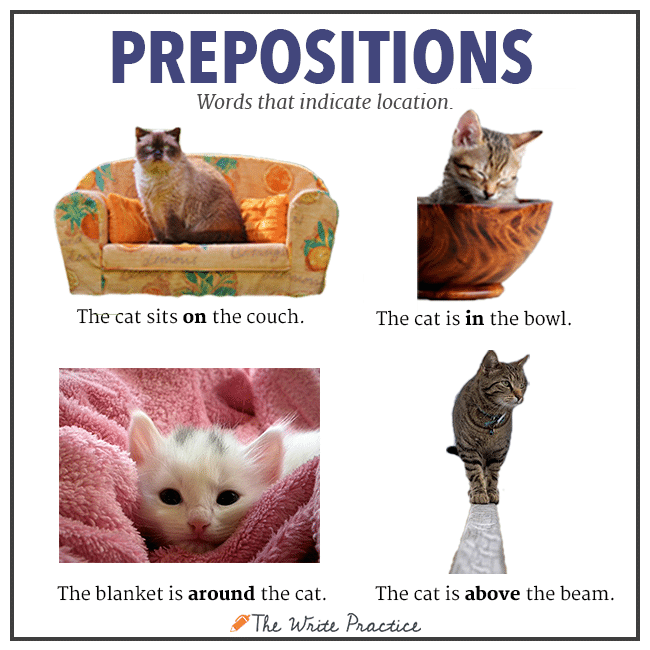
First, a quick review: what is a preposition? These cats explain it pretty well.

What is a preposition?

To sum up:

The prepositions above show the cats’ locations in space. Let’s add to the fun with these prepositions that show location in time:

I fed the cats at seven this morning.

Pamela will clean the seven litter boxes in the evening.

After you pet the cats, wash your hands before you eat, please.

Is Ending a Sentence With a Preposition Bad?

Recently, we talked about the “rule” that you shouldn’t split infinitives and why it’s really okay.

The bottom line: a few centuries ago, when our grammar was a murky mess, some outspoken grammarians decided to apply Latin rules to English, regardless of whether that was a sensible choice.

In this case, dramatist John Dryden was the first to take up the pen against ending sentences with prepositions, way back in 1672. He claimed that since you can’t end a sentence with a preposition in Latin, you shouldn’t do it in English, either.

The Problem With Following the Rule

English isn’t Latin, though, and we structure our sentences very differently. It’s easy to construct perfectly logical and grammatically sound sentences whose only “fault” is that they end with prepositions.

Plus, when you try to “fix” these sentences, you can end up with some pretty crazy twists, like this quote often misattributed to Winston Churchill:

“This is the sort of nonsense up with which I will not put!”

And as we recognize how arbitrary and baseless this rule was to begin with, we’ve moved away from strictly adhering to it. So if you’ve ever written yourself into a corner fretting over the preposition rule, breathe deep.

It’s okay to end a sentence with a preposition.

That being said, there are a few caveats.

When It’s NOT Okay to End a Sentence With a Preposition

If the meaning of the sentence is still clear without the ending preposition, then remove it.

In my hometown in the hills of western PA, it’s not uncommon to overhear someone on the phone asking, “Hey, where are you at?” “Where are you” doesn’t need any clarification, so cut that “at.”

Then again, it’s also not uncommon to overhear someone refer to a group of people as “yinz guys,” so I’d hardly claim my hometown as a beacon of good grammar and usage.

However, if the preposition is key to the sentence’s meaning, and moving it would cause unnecessary written acrobatics, it’s fine to end your sentence with the preposition. For example:

Carla wanted to run, but her feet refused. What was she waiting for?

Rewriting that last phrase would completely convolute the prose. No one asks, “For what was she waiting?” Come on now.

Ditch Dryden (Or Don’t)

Is it okay to end a sentence with a preposition? Yep.

Is this claim controversial? You bet.

Still . . . maybe it’s time to rethink how much we pay attention to those Latin-obsessed 17th century introverts.

Have you heard the “rule” (*cough* myth) that ending a sentence with a preposition is a grievous error? Do you ever end sentences with prepositions? Let us know in the comments section.

PRACTICE

Joe here. Liz couldn’t think of an exercise for this one so she put it in my hands. Big mistake, Bureman. Liz’s reverence for grammar is equal only to my mockery for it. So today we’re going to take the “it’s kind of okay to end your sentence with a preposition” rule to its logical conclusion.

Let’s end every sentence with a preposition.

Go to this list of prepositions if you need to, and try to write as many sentences ending with a preposition as you can in fifteen minutes. It’s okay if the sentences don’t go together, but you get bonus points for, one, the funniest sentence and, two, the best imitation of a Western Pennsylvanian.

When your time is up, post your practice in the comments section along with how many prepositions you used.

Good luck, yinz guys!

The post Is It Okay To End A Sentence With A Preposition? appeared first on The Write Practice.


from The Write Practice http://ift.tt/2CxVdgE

First Look: Cobra’s King Utility Black and King Utility Black ONE

In April 2016 Cobra officially signed reigning NCAA and U.S. Amateur champion Bryson DeChambeau to a long-term sponsorship deal. Amongst other things, this move necessitated that Cobra develop a consumer-ready set of single-length (Cobra uses the term ONE Length) irons to approximate those in DeChambeau's bag.

Without the typical window for R&D, Cobra focused its efforts on two models, KING F7 ONE and KING FORGED ONE. That was 2017. This is 2018 and as Cobra is still the only major OEM to delve into the "One Length" concept of golf equipment with any level of fidelity. With that, Cobra is making it clear it intends to continue introducing new clubs throughout the line up with ONE length variants.

COBRAUTILITY-1

Enter KING Utility Black and King Utility Black ONE. Both clubs are virtually identical (same tech platform and general aesthetic) with the clear distinction being that the Black ONE is the same length as a stock 7-iron.  The chief engineering challenge with single-length long irons is that most players don't have the requisite clubhead speed to swing a comparatively shorter club fast enough to generate the needed launch/spin requirements to hit anything other British Open worthy knee-high bullets. Cobra feels this iteration can help address that.

TECH STUFF

Both models feature a black PVD coating, hollow body construction, forged CNC milled faces, and grooves as well as Cobra's MyFly8 adjustable hosel. Specifically, Cobra's PWRSHELL Face Technology utilizes a forged 455 high-strength steel face on top of a completely hollow-body. The thinner face and multi-material construction increase the Sweet Zone which theoretically should mitigate the less desirable effects (lower launch, less distance, and increased dispersion) associated with mishits.

Also, of note is that the face is completely unsupported, meaning the body of the club is left hollow, whereas some OEM's fill this space with fancy goo or foam (PXG, TaylorMade) for structural support and to manage acoustics/feel of impact. In this case, the lack of material is what allows engineers to keep the CG low to help promote higher launch. Because Cobra doesn't use the hollow space for internal weighting, a tungsten toe weight (67-73 grams in the Variable iron and 90-94 grams in the ONE Length version) is necessary to reach the desired total weight and maintain a relatively neutral bias.

COBRAUTILITY2-1

Everything being equal, KING Utility Black and KING Utility Black ONE are engineered to outperform a typical long iron, while still maintaining a similar footprint. Principally, better performance means increased ball speeds, more forgiveness and higher launch characteristics for players who need it.

Like all 2018 COBRA KING equipment introductions, both Utility Black irons offer golf performance tracking via the COBRA CONNECT platform (powered by Arccos). For those unfamiliar with Arccos, it uses sensors embedded in the butt end of the grip to track your performance in real-time.

This is an important year for Cobra as it looks for opportunities to regain some retail momentum and while taking metalwood market share from either Callaway or TaylorMade feels like carving a tunnel out of granite, the single-length equipment space appears to be where Cobra feels it can make some serious headway. Admittedly, there was more buzz around the concept last year, and industry sales figures of single-length irons reflect this. What remains to be seen is whether the interest level has waned at all or perhaps if additional ONE Length offerings might stoke the proverbial fire a bit. Regardless, so long as other OEM's largely sit this one (length) out, any increased demand for single-length equipment in the short-term should disproportionality benefit Cobra. If the concept has lasting merit, however, I'd suspect it won't be long until we see one of the heavy hitters jump into this space as well.

COBRAUTILITY2-3

The Utility Black ($219 graphite) is available as either a 3 iron (18°-21°) or 4 iron (21°-24°) and comes stock with the UST Recoil 760 (Lite flex) or 780 ES SmacWrap (Regular, Stiff and X-Stiff). It's ONE Length counterpart adds one additional club, a 5 iron (24°-27°) and drops the Recoil 760 Lite flex option.

The steel shaft option ($199 and custom only) is a True Temper AMT Tour White with black powder finish. Available only for right-handed players, both clubs will be available April 6th.

Is Cobra on to something or will single length be more of a sparkle and fade?


from MyGolfSpy http://ift.tt/2EEDRV7