Tuesday, April 9, 2019

First Look: Callaway Sure Out 2

Greetings class. We’re going to start today’s story with a little group exercise.

Everyone who makes their living playing golf for money, raise your hands. Good, good – you guys are excused. See you next time.

Next, everyone who is a high performing, competitive amateur – you’re excused as well, as is anyone who’s a mid- to low-single-digit handicap or better and who practices at least three or four times a week.

Actually, the only people who need to stay are those of you who play golf for fun, but the fun dwindles considerably as you get closer to the green and goes away completely when you land in the sand. And if you firmly believe those who bleat “GET LESSONS” really need to get over themselves and just lighten up because not everyone is as avid as they are, you guys can stay too.

Now that we have your attention, let’s proceed to our latest release du jour– the new, improved, updated and expanded Callaway Sure Out 2 wedge.

Wedge for The Common Man

Golf is a game, and games are supposed to be fun, right? If you’re a weekend warrior, high handicapper or just a regular guy/gal who likes playing golf, but with a wife/husband, kids and a job that actually requires you to show up every day, you really can’t spend as much time practicing as you’d like. That’s life, and for that golfer, the sand – and the short game in general – are Five Alarm Fun-Suckers.

GET FIT FOR YOUR GAME WITH TRUEGOLFFIT™

Unbiased. No Guesswork. All Major Brands. Matched To Your Swing. Advanced Golf Analytics matches the perfect clubs to your exact swing using connected data and machine learning.

SEE MY RESULTS

The Callaway Sure Out 2 certainly isn’t new or even unique technology (Hogan gave us the original Sure Out years ago), but the super-wide flanged wedge idea does work, as proven by a MyGolfSpy test a little over 16 months ago. Unfortunately for Callaway, the original Sure Out was the worst performing of the three specialty wedges tested, and it wasn’t close.

The MyGolfSpy test exposed two glaring deficiencies in the Sure Out. First, despite its name, the Sure Out wasn’t – it fared no better for our testers than a traditional wedge in actually getting the ball out of the bunker. Second, the overall proximity to the hole was actually worse with the Sure Out than with a traditional wedge. For perspective, the other specialty wedges tested – the Cleveland SmartSole and the infomercial special C3i – both performed markedly better than the traditional wedge.

So, for the Sure Out – a wedge designed to make getting out of the sand damn near automatic and getting closer to the hole a piece of cake for the weekend warrior – that’s kinda not good, not to mention ironic. Clearly, there was room for improvement.

Tweaks ‘n Such

Callaway may not have been influenced by our test, but the company does say it acted on feedback and testing for its Sure Out 2 upgrades. First, Callaway says it has enhanced the sole radius and bounce angle and has added some heel relief – which ideally should improve sand performance and around-the-green playability. As with the original, Sure Out 2 features coast-to-coast face grooves (a la the PM Grind wedges) and there’s a new Lamkin Step Down grip, which features three markings to help the target golfer figure out where to place his or her hands for different distances.

The original Sure Out was available in only two lofts (58oand 64o). Sure Out 2 brings more options with a 56oand a 60oadded to the mix, and all lofts will be available for both righties and lefties. The shaft lineup is lightweight across the board (again, consider the target demographic), with the KBS Wedge 90 in steel and the UST Mamiya 65 and Fujikura Women’s 50 in graphite.

As this is the second iteration of Sure Out, it’s safe to say there’s enough of a market for this type of club to keep it current. Cleveland is on its second iteration of SmartSole (the calendar suggests a third might not be far off), and the C3i is still out there and available online, and we haven’t even discussed the Alien Wedge. Bottom line: it’s reasonable to presume this is now an actual product category. Obviously there’s the traditional blade-style wedge, and Cleveland has done a nice job of establishing its CBX as a Game Improvement wedge. This category, seemingly, is a Super-Duper Game Improvement wedge because, you know, an awful lot of people just play this game for fun.

Sure Out 2 hits the stores and Callaway’s website this Friday. It will retail at $119.99.

For more information, visit Callawaygolf.com.


from MyGolfSpy http://bit.ly/2P1Pibf

FIRST LOOK: Ben Hogan PTx PRO Irons

Have you ever had a club you wish to hell you’d never got rid of? For me, it was a set of Y2K Hogan Apex Plus irons. They didn’t have much sentimental value – I bought them on eBay for about $75. They had plenty of bag chatter, some nice wear marks right on the sweet spot and felt like a foot massage from a young Kathleen Turner. Loved the look, too, with the Hogan signature and the Sunburst logo –  just the sight of them made my heart do the Rhumba.

I don’t know who’s holding them now, but I want them to know I still love them and miss them terribly.

For any old-school Hoganistas out there who loved the Spalding-era ’99 Apex blade or ’00 Apex Plus, you might be in for a little flashback with this week’s release of the new Hogan PTx PRO forged irons.

They take you back a bit, don’t they?

Hello Old Friend

“We spent a lot of time on the graphic presentation as much as we did the technology,” says Hogan CEO Scott White. “We wanted to get back to the Hogan history and heritage, and we wanted something people would instantly recognize as being a Ben Hogan design.”

The new new Ben Hogan Company has had a bit of a branding problem. The Ft. Worth blades, the old PTx cavity backs, and last year’s Edge game improvement irons, while all fine sticks in their own right, had no branding consistency. They’re all members of the same family but look like they all came from different fathers.

The new PTx PRO still doesn’t fit with the other two irons sets, but it does look enough like the Apex Plus and its Spalding/Callaway progeny Apex Edge and Apex FTX to be listed as a direct descendant on Ancestry.com.

“If I have any criticism of our product line is there’s not a lot of consistency in how our irons look,” says White. “Going forward you’re going to see more and more products that look like and have the aesthetics of the PTx PRO.”

The original PTx irons were released in 2016, the last club released by Hogan before it declared bankruptcy in early 2017. Since rebooting in August of that year, the PTx has been Hogan’s best-selling iron, but three years later, it’s due for an update.

The obvious updates are aesthetic, but there are a couple of things under the hood that should matter to you.

GET FIT FOR YOUR GAME WITH TRUEGOLFFIT™

Unbiased. No Guesswork. All Major Brands. Matched To Your Swing. Advanced Golf Analytics matches the perfect clubs to your exact swing using connected data and machine learning.

SEE MY RESULTS

Co-Forged, 3-Piece

If you define forged irons as an iron forged from a single piece of steel then no, the PTx PRO doesn’t qualify. That line, however, continues to be blurred by OEMs offering multi-piece heads with forged components. In that sense, Hogan isn’t breaking any new ground with the new PTx PRO’s. In fact, other than aesthetics the long irons in both the old and the new PTx irons appear to be virtually identical. Both sets’ long irons feature hollow-bodied, three-piece co-forgings, with forged 1025 carbon steel frames and forged MS300 faces. Tungsten weights are placed in the toe area to fine-tune CG, launch angles and spin.

The scoring irons (8-PW) are also fairly similar in construction to the original PTx irons. Like the old irons, the new PTx PRO feature the forged frame and face, with lighter titanium cores to help lower the CG, but there are slight differences.

“Feedback we received from users of the original PTx was the short irons had a tendency to balloon a bit,” says White. “The new irons have titanium cores of different sizes and geometry to lower the CG, so new they’ll deliver a much more penetrating trajectory compared to the original set.”

Hogan calls it Linear Center of Mass Weighting, which keeps the CG as a consistent level throughout the set for consistent launch. “We had it in the original PTx irons, but we think we’ve perfected it in the PTx PRO,” says White. “You’ll get consistent mid- to higher-trajectory with the long irons and mid- to lower-trajectories with the scoring irons, which is what most accomplished players want.”

As was the case with last year’s updated Ft. Worth irons, Hogan has modified PTx PRO V-Sole, with a more aggressive bounce on the leading edge and a softer bounce on the trailing edge.

“It not only allows a good player to manipulate the clubhead for any lie, but it really reduces turf interaction,” says White.

Specs, Pricing, and Availability

We haven’t seen or tried the new PTx PRO irons yet, so there’s no practical feedback we can give. The original PTx was included in our 2017 Most Wanted Player’s Iron testing and scored very well in ball speed and carry distances, but both the long and short irons dropped off when it came to accuracy. The technical updates to the scoring irons, Linear Center of Mass Weighting and V-Sole are helpful tweaks that should address those areas, but certainly seem to be playing a supporting role to the obvious aesthetic upgrade.

The loft structure remains what purists would consider more or less traditional, and are identical to the original PTx irons, starting at a 22-degree 4-iron with four degree loft increments up to a 46-degree pitching wedge.

Hogan is making the PTx PRO available in 5-, 6- and 7-piece sets, depending on how long of a long iron you’d like in your bag. With Hogan’s direct-to-consumer pricing, the 7-piece set (4-PW) sells for $770.00, the 6-piece set (5-PW) sells for $690.00 and the 5-piece set (6-PW) sells for $600.00.

Per usual with Hogan, all loft/lie alterations and grip options are no extra charge, and there’s no upcharge for graphite shafts. Hogan’s shaft offering is quite limited: KBS Tour-V, KBS Tour 90, True Temper Dynamic Gold and UST Mamiya Recoil, which White says can fit about 99% of the golfers who call in. “We do get calls for some of the exotic and more expensive shafts, but we’re still trying to keep our cost structure under control, and we can’t inventory every shaft in the world. If we lose an order because of a shaft we don’t carry, well, I can live with that.”

Hogan is also introducing a new Flat Rate International shipping option. Any order over $400 can be shipped almost anywhere in the world for a $40 flat rate – not including duty or taxes (those remain the responsibility of the buyer). White does say there are a few places, such as Australia, where the flat rate is $50, but for Europe and most other parts of the world, it’s only $40.

The PTx PRO irons are available today on the Ben Hogan website.

Filling the Bag

It’s been a busy spring for Hogan. A couple of weeks ago the company released a quartet of putters – three blades and a mallet – the first Hogan putters of consequence since the Bettinardi-made lineup, again from the Spalding era.

“It would have been easy to just whip up some investment cast putters and stamp the Ben Hogan logo and the back and be done,” says White. “But that’s not what we wanted to do.”

The new Precision Milled Forged Putter line features the Hogan Sunburst logo on the heel of each milled face and the iconic Hogan signature on the back, but it’s the forged part that piques the curiosity. According to Hogan, the putter head itself is CNC milled, but it’s milled from a forged hunk of 1029 carbon steel as opposed to an investment cast hunk of steel.

“99.9% of the putters on the market right now – even some of the high-end putters – start with liquified metal that’s poured into a mold. That’s the block you start with,” says White. “We start with a piece of metal that’s been forged. The grain structure hasn’t been compromised; it’s been hammered into place.”

The milling process after that forging isn’t all that different from the process with a piece of cast metal. It’s all a case of what you’re starting with.”

White says the difference is primarily in feel, sound, and consistency. Whether there are any actual performance benefits is an open question.

“We don’t expect, nor do we have any ambition to challenge the market leaders,” says White. “But we know these are great performing putters for those people who are kind of tired of the same old run of the mill putter.”

Hogan’s Precision Milled forged putters feature a Diamond Black Metal finish, are available on Hogan’s website for $250.00. Length and lie alterations and your choice of one of three SuperStroke grips are included in that price.

18-Month Health Checkup

Hogan 3.0, the reorganized, factory-direct company that rose out of bankruptcy court in August of 2017, in reality, is a 20-month old virtual startup. As such, the company is intent on staying lean as it grows. The assembly and shipping team at its Fort Worth facility is small, and the company outsources many of its core functions, including finance and some R&D. It’s trying to avoid out kicking its coverage, as its immediate predecessor did.

“We had a great year in 2018,” says White. “The factory direct or Direct-to-Consumer model absolutely, positively works. More people are visiting our website and placing orders, so they understand they can buy premium equipment without retail markup.”

And while you can’t go into a store and demo anything Hogan, you can try its 14-day Demo Program: for $20 you can demo a 2-club set for two weeks ($30 if you’re in Europe). Startups such as New Level and Sub70 offer similar programs, as does Bridgestone. While it’s not the same as whacking a handful of shots into a simulator while shopping for balls and tees, you do get to try the clubs on the course for a couple of weeks. Hogan says over 70% of the people who try product via the Demo Program wind up buying.

And Hogan isn’t done this spring. White says you can expect a specific progressive/combo iron set sooner rather than later. Instead of cobbling existing irons into a hodgepodge, White says the combo set will be specifically designed as a unified irons package. You’ll see other additions as well – again sooner rather than later – but the company is keeping mum about what those might be.

“I think going forward you’re going to see more and more products that look like and have the aesthetics of the PTx Pro,” says White.


from MyGolfSpy http://bit.ly/2X334xt

Monday, April 8, 2019

First Look – TaylorMade P-7TW Tiger Woods Irons

The doors had barely opened at the 2017 PGA Merchandise Show when TaylorMade officials confirmed what most expected – it was signing Tiger Woods to a multi-year endorsement deal for an unspecified amount. Immediately, gear heads began to pontificate as to which clubs the Big Cat would bag – knowing the driver and metalwoods would likely be a quicker and easier transition, with the wedges and irons lagging behind. TaylorMade indicated as much stating its engineers would be working directly with Tiger to compose a “new and personalized iron model” down the road.

The first glimpse came in the form of TW-Phase 1, a set of irons Tiger used for much of the second half of the 2018 season after recuperating from yet another back surgery, which again brought his competitive golfing future into question. Admittedly, TW-Phase 1 didn’t look altogether different from the various muscle-back irons Tiger had played throughout his career. This included a combo set of Mizuno MP-14/MP-29 he used an amateur, which became the foundation for the 681 “T” blades he used to achieve the Tiger Slam of 2000 while on staff with Titleist. Tiger moved to Nike’s MB irons in 2002 and for the next decade-and-a-half, give or take, each version looked to the casual observer pretty much like the previous one.

After all, a blade is a blade is a blade, right?

Sort of. With that, TaylorMade is making available to the public a limited number of P-7TW (keeping the P7-something naming convention) irons which are the same irons as those in Tiger’s bag, save for a few small details (lie angle and shaft).

GET FIT FOR YOUR GAME WITH TRUEGOLFFIT™

Unbiased. No Guesswork. All Major Brands. Matched To Your Swing. Advanced Golf Analytics matches the perfect clubs to your exact swing using connected data and machine learning.

SEE MY RESULTS

Tiger is notoriously picky about his equipment, exhibiting a refined sense of feel largely unparalleled, even within the professional ranks. Most people can tell if they don’t put socks on correctly. Tiger can tell if a pair is missing a couple of threads. To take a mediocre analogy a step further, to say TW is picky about his equipment is like saying I’m fond of hot tubs and ice cream.

Between the TW-Phase 1 and P-7TW TaylorMade engineers worked through nine different rough drafts before landing on a final edition with everything dialed in precisely to Tiger’s liking. The head is forged from 1025 carbon steel, but TaylorMade is showcasing fully milled soles (the first time TaylorMade is using this application on something other than a wedge) to produce the precise turf interaction Tiger desires. Tiger changes iron sets twice a year, and the milling process removes the need for Tiger to hit hundreds upon thousands of golf balls to find a set that’s right. For a guy with a fused back and multiple surgeries, any reduction in superfluous wear and tear is a good thing.

The chief benefit of milled grinds is, because a CNC machine (and not a human) is doing the work, the milling processes (which take about one hour per head) are exact; generating the same grind over and over to precise tolerances, with variances so minuscule it’s likely beyond what even Tiger can discern.

Compared to the P730, the heel-toe length on the P-7TW is a hint longer, and some irons have a shorter hosel length (PW is 3 mm shorter). Additionally, the CG location (courtesy of tungsten slugs) moves toe-ward in the short irons. With Tiger, CG manipulation isn’t strictly to optimize generally accepted performance parameters– it’s about getting each iron to launch through a precise window with an ideal trajectory and spin. Additionally, Tiger likes to generate more spin on iron shots (part of why he uses Bridgestone’s Tour B XS ball), so the grooves are narrower and more aggressive than typical TaylorMade mass market irons.

Other notable, Tiger-specific attributes are fixed offset amounts (4,5 and 6 irons have the same offset as do the 7, 8 and 9 irons) and larger print numbers on each club. The former again has to do with dialing in trajectory, feel, and individual performance while the latter is simply so as not to pull the wrong club in high-pressure tournament scenarios. Tiger’s actual gamers do have flatter lie angles and more loft than the retail version, though loft and lie are easily adjusted if buyers want the full Tiger experience.

The P-7TW irons are further validation that we might be seeing consumer’s preference for high-end equipment shift from handmade, individual one-off pieces to CAD designed, CNC milled equipment. The machines have certain advantages – namely precision, replication, and scalability which, when it comes to golf equipment, is a comparative advantage. No doubt it’s why Cameron replaced the 009 putter with the 009M and why PXG’s line of fully-milled wedges set a new standard for wedge production – and it’s not as if either has decreased in popularity or cost.

At the end of the day, the P-7TW is a limited edition set of clubs built for arguably the best player to ever tee it up. Ostensibly, it’s a set of irons most of the golfing world has no business playing – but that’s the point. These are Tiger’s clubs and the novelty of owning (and possibly playing) his clubs is more than enough reason TaylorMade is likely to sell as many sets of irons as it’s willing to produce.

AVAILABILITY:

P-7TW Iron sets are available in right-hand only with pre-sale orders beginning today. Retail availability begins May 1st.

The price is $2000 (3-PW), and each set will come in a special, limited-edition box.

The stock shaft is Dynamic Gold Tour Issue S400 though a full slate of no-upcharge options is also available.


from MyGolfSpy http://bit.ly/2VrOsal

BEST SPIKED SHOES OF 2019

Friday, April 5, 2019

Boring First Page? Here’s How to Start a Story

Opening scenes are just hard. Figure out how to start a story right and you capture the reader, set the tone, and propel the story forward. Do it wrong, and you risk losing a reader. Here’s one opening to avoid: the empty stage setting.

Boring First Page? Here's How to Start a Story

When my students and I work on story openings, we focus on presenting a character with a problem in an active setting.

Emerging writers tend to list the setting or character details or flat out state the problem. The effect feels like an empty stage where we drag out costumes, set flats, and various props before the story gets started. Like this:

John entered the room, his overcoat hanging from his hand. At six feet tall, he held an umbrella in the other hand. He looked out the window by the front door expectantly. He began to pace.

“She’s late again,” he said aloud to the wallpaper.

The Problem of an Empty Stage

This excerpt hints at the problem or conflict (she’s late, he’s waiting and pacing), but we know nothing else about him. The setting is a big blank space.

First, I pull in John with an overcoat. Then I add that he’s six feet tall: but why does that matter for this scene? It feels like a casting detail. Next I give him another prop with the umbrella. Then I paint a window next to a door before John starts walking.

It’s an unconnected list that doesn’t effectively get the story in motion.

Our goal is to immerse a reader in our world right away, not force them to sit and watch while we paint the set and dress the characters on an empty stage.

The Antidote to Empty Stage Openings

Two things can cure an empty stage opening: specificity and action. Look back at the initial excerpt and see if you can find four or five details that are too general.

Who’s John and what makes him tick? What room? What kind of overcoat and umbrella? 

We don’t have to burden the scene with overly detailed descriptions of each of these things, but it helps to know which items have significance and need the reader’s attention.

Once I’ve selected the details that most need specificity, I need to get this character in motion. Having John pace can work, but how can I incorporate other action that reveals his personality and the things he cares about?

How to Start a Story . . . Better

John’s crisply starched khakis swished as he paced the dingy motel room, stopping only to scan the parking lot outside for signs of Nadia’s blue Impala. A steady drip sounded from the bathroom.

“She’s late again,” he said, glancing at the red digital numbers beside the bed before stopping to stare out of the barred window.

The sun beat down on the tired asphalt outside, and John shifted his tan overcoat and oversized umbrella to one hand, letting their absurdity weigh on him. Nadia would laugh at him. If she ever arrived.

In this revision, we’re focusing on the contrast between John’s fastidious dress and manner against a dingy motel room and the person he’s waiting on. He’s uncomfortable, as indicated by his pacing, the barred windows, and the steady drip. When you use specific details to show us what the character notices, it reveals the character’s personality without having to resort to lists or stage directions.

Empty stage openings are easy to fix if you focus on specificity and action. See what sensory details you can add to your work in progress and create ways to put your character in motion. 

What openings are least effective for you and why? What tips do you have for stronger story openings? Share in the comments.

PRACTICE

Today, you have two options. Rewrite the opening excerpt about John, highlighting different details and action.

Or, look at your current work in progress. Evaluate the use of sensory details and action, then rewrite the first ten sentences.

Take fifteen minutes to write. When you’re done, share your opening lines in the comments below, and be sure to leave feedback for your fellow writers!

The post Boring First Page? Here’s How to Start a Story appeared first on The Write Practice.


from The Write Practice http://bit.ly/2UwTF3l

2019 #SpyStaffSlam – The Masters Edition: Win A Custom Set of Wilson Staff Irons

We’re a week away from that annual east Georgia get together known as The Masters, and as always, there’s intrigue galore: can Rory finally break through for the Career Grand Slam? Can Brooks cop his third major in less than a year? Is Rickie finally due for a trip to the winner’s circle?  Is Dustin due for another trip down the stairs? And when, where, and how will Jordan blow up?

The Masters truly is a tradition unlike any other. MyGolfSpy’s annual #SpyStaffSlam is becoming one as well. MGS, along with the good folks at Wilson Staff, want to make your Masters weekend a bit more interesting with the first of our four #SpyStaffSlam contests.

First prize is a fully customized set of Wilson Staff irons – anything from the all-new long and forgiving D7’s and C300’s to the C300 Forged and 2017 Most Wanted Players Iron, the FG Tour V6. It’s your choice.

Wilson Staff Masters logo

Call Me Intrigued!

The contest is pretty simple to enter. You pick a 4-person team, and if your team combines to win to the most total prize money, you win too. As we said, 1st prize is a full set of Wilson Staff irons custom built to your specs, 2nd prize is a Wilson D7 driver, and 3rd prize is a dozen Wilson DUO golf balls (Professional, Soft or Soft Spin – your choice of color).

And this is only the beginning. We’ll be doing the same thing all over again for the U.S. Open, the Open Championship, and the PGA. Wilson Staff has won 61 of these things, you know, but hasn’t seen the winner’s circle at Augusta since ’93 with Bernhard Langer. Could Gary Woodland break through this year? Can’t wait to find out!

How To Enter:

It’s easy to enter, but make sure to read carefully and follow the directions to the letter, so you don’t miss out.

First, if you haven’t already, you must join the MyGolfSpy Community Forum (click here to sign up).

Next, in the official MyGolfSpy #SpyStaffSlam Master’s Contest Thread in the Community Forum (click here), select and enter your team from the provided tiers. You’ll also need to enter your tiebreakers, just in case.

It’s pretty simple, but make sure to enter your selections only in the contest thread in the Community Forum. We’ll announce the winners in that thread Monday after the Masters.

You won’t get a green jacket, but then again, a green jacket won’t knock it stiff from 160!


from MyGolfSpy http://bit.ly/2WOIUXO

Thursday, April 4, 2019

ProWritingAid Review: Will This Grammar Checker Fix Your Writing Issues?

ProWritingAid is a grammar checker and style editor meant to help you improve your writing and become a better writer. How does it work? And would it be a useful tool for you? I tested it to find out, and I’ll break it all down for you in this ProWritingAid review.

ProWritingAid Review

If you’ve ever written any piece of writing, you know that mistakes are inevitable. They happen to the best of us: from pesky typos to not finding quite the right word to so many grammatical nuances it’s hard to keep track.

Of course, having an editor or a writing teacher always on hand to correct all those mistakes would be ideal. (I’m an editor myself, so I’m a little biased, but it’s true.) There’s no replacing the knowledge and experience of a real, live human who understands how language works and who can help you communicate your ideas in the best way possible.

But if you don’t have access to an editor (or if you do, but you don’t want to hire them to edit your emails or Facebook posts), grammar checking software like ProWritingAid is an accessible, affordable alternative.

An Editor’s Review of ProWritingAid

I’ve heard great things about ProWritingAid from other writers I trust. As an editor, though, I was dubious. Could a piece of software really find all the errors in my writing? Could it really serve as a helpful substitute for a human editor? Would it help writers find and fix the problems in their writing and grow in their craft?

And I’ll admit too that I had one more question: could I write so perfectly that ProWritingAid would find nothing to critique?

I set out to test ProWritingAid myself and see how it works.

Before we get started, I wasn’t paid to write this review, but I do want to be fully transparent and let you know that the links in this article are affiliate links. If you sign up for ProWritingAid, it will help me be able to keep writing (and help me continue sharing what I’ve learned about the writing process). Of course, this won’t affect your overall price, and it didn’t affect my decision on the program — like I said, I’m starting from a place of skepticism.

Take a look at ProWritingAid here. How does it stack up? Here’s what I’ve found.

ProWritingAid Review: The Basics

First, a brief overview: what is ProWritingAid?

ProWritingAid describes itself as “a grammar guru, style editor, and writing mentor in one package.” It’s a piece of writing software that acts as an intricate system of grammar checkers, spell checkers, and style checkers.

ProWritingAid is designed for writers, editors, copywriters, students, and other professionals. Whether you’re new to writing or a seasoned author, it has features that will give your writing a boost at every level.

It’s available in both a free version and a paid premium version. Of course, in the premium version, you’ll get significantly more options and support.

What features does it include? Let’s take a look.

Grammar and Spelling Checkers

This is the cornerstone of any writing aid software, and ProWritingAid delivers. It has robust grammar and spelling checkers, more thorough than even Microsoft Word.

Errors are underlined in red for spelling and blue for grammar. My favorite feature here is that when you mouse over the underlined text, a little box pops up with not only a suggested correction but also an explanation of why it suggests this correction at all.

Plus, there’s a real-time error checker that will count up all the issues it finds and point you to them with a single click. Don’t want to see how many issues it spots as you write? Turn it on or off at any time.

This isn’t just an error fixer. It’s a teaching tool: pay attention to the issues it notes, and you’ll become a better writer.

Customization for Your Writing Style

As an editor, one of the first questions I ask of any piece of writing is, who is this writing for? Who is the audience? And with that in mind, what’s the best approach for this piece?

A Facebook post, for instance, is casual and informal. A legal document, on the other hand, is very formal. Blog posts, novels, memos, emails, and essays all fall on a spectrum in between.

ProWritingAid is designed to adjust for your specific writing purpose. You can change your writing style at any time from a drop-down list of options:

  • General
  • Academic
  • Business
  • Technical
  • Creative
  • Casual
  • Web

Whether you’re writing a business report or a tweet, ProWritingAid will customize its suggestions for you.

More Than a Dictionary and Thesaurus

Most writing tools come with a built-in dictionary and thesaurus. ProWritingAid takes it a step farther with a dictionary, a thesaurus, and a wide variety of word suggestion tools.

Looking for the perfect word for your English paper? Try the standard dictionary and thesaurus. Mouse over any underlined word and it will offer a list of alternate suggestions.

Writing poetry and need a lyrical line—or want to avoid overusing alliteration in a serious document? There’s an alliteration analysis for that.

Drafting a brilliant new story and want to make sure you haven’t relied on a slew of clichés? The cliché and redundancy report will catch them all.

Not sure if you’ve used the right there, their, or they’re? The homonym check will evaluate your word usage and correct any misplaced words.

With all these tools, you’ll be sure to use the right word at the right time all the time.

Robust Reports on Your Writing

So far, so good. To this point, I’ll admit I was feeling pretty confident in my ability as an editor to best ProWritingAid.

But here, it provided analysis that even I, for all my love of grammar, couldn’t gather without ProWritingAid’s help.

I mentioned several of ProWritingAid’s dictionaries, reports, and checkers above. Those barely scratch the surface of the tools ProWritingAid offers.

There are more than twenty reports you can use to analyze your writing in a variety of ways. I won’t cover them all, but I want to highlight a few of my favorites.

The Writing Style Report

After the grammar and spell check tools, this might be one of the most useful reports for quickly and easily cleaning up your prose. The Writing Style report evaluates your writing for adjustments that can enhance its readability. It identifies writing style elements like:

  • Passive voice
  • Hidden verbs
  • Overuse of adverbs
  • Repeated sentence beginnings

At a glance, it will show you exactly where you can make small tweaks to your writing that can improve the style and create a better experience for your readers.

The Word Count and Sentence Length Report

Many writing tools include word counters, but the Sentence Length report is so much more powerful than that.

It will count the number of words and characters in your document, yes. But it will also count every word in every sentence and display them in an illuminating visual. You’ll see your average sentence length and how much your sentence length varies, and it will warn you of any particularly long sentences.

When you know what you mean to say, it can be hard to tell where readers won’t understand. The Sentence Length report is a helpful way to catch lines that might be confusing so you can break them apart.

Three Reports to Beat Repetition

ProWritingAid includes not one, but three reports to help you catch any repetitive words.

The Overused Words report will mark any overused words, ones used so many times that they’ll definitely make readers pause. Plus, it will tell you how many instances to remove so they aren’t overused anymore. It will even compare your use with other published writing so you can see how your style stacks up against other similar works.

The All Repeats report will mark words and phrases up to four words long that you’ve used repeatedly throughout your text. They aren’t necessarily overused, but it’s helpful to be aware of anything you tend to repeat.

The Echoes report will mark any words or phrases that are repeated in close proximity to one another. It will also suggest alternative words you can use to break up the repetition.
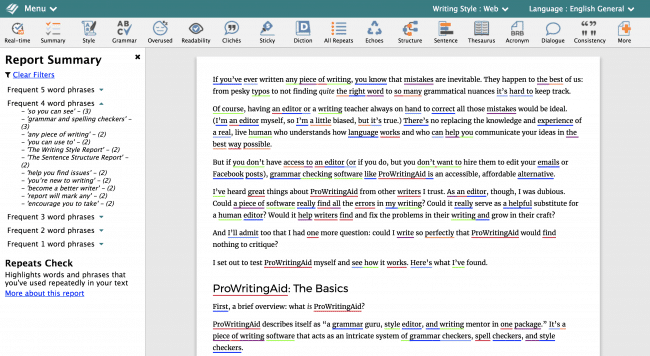
The Sentence Structure Report

The Sentence Structure report is one I personally find fascinating. It reviews all the ways you structure your sentences so you can see where you’re repeating certain syntax.

For instance, 37% of my sentences start with a subject, but none start with a gerund. That’s neither right nor wrong, but it gives me helpful direction for how to increase the variety in my writing.

The Pacing Report

This is the kind of report I wasn’t expecting, but was so excited to find. The Pacing report is an amazing tool for creative writers.

Some backstory is good; too much, and you’ll start to bore your reader. This tool will identify any sections of your manuscript that slow the pace so you can see at a glance whether it’s too much or just right.

The Plagiarism Report

Plagiarism is a huge concern for writers, and the Plagiarism report will help put your mind to rest. ProWritingAid has scanned millions of articles, books, and academic papers, and it will analyze your writing for any lines that appear in other documents.

Unlike other ProWritingAid reports, the Plagiarism checker isn’t included in the typical Premium package. You can upgrade to Premium Plus for fifty plagiarism checks per year, or you can purchase checks to use as you need.

The House Report

Do you write for an organization that has a house stylebook? Do you want ProWritingAid to check for specific rules or patterns in your writing?

The House report is a blank report you can customize to be completely yours. Tell ProWritingAid what you want it to analyze, and it will produce a report.

Analyze to Your Heart’s Content

I’ve mentioned nine of ProWritingAid’s reports above, but that’s not even half of what this tool can do. I encourage you to take a look at the full list here, or even sign up for a free trial so you can play around with it yourself.

With these reports, you can get as granular as you like in your writing analysis. Take a deep dive into readability with the Readability report, nitpick every inconsistent detail with the Consistency report, or simply correct grammar errors and move on with the Grammar report.

No matter what kind of writing you’re working on, there’s a report that will help you refine your piece and become a better writer.

Where to Use ProWritingAid

You can use the ProWritingAid editor directly on the ProWritingAid website. Draft your writing there in the editing tool, or copy and paste it in from another document.

But you’re not locked in to the ProWritingAid website. Whether you write in Microsoft Word, Google Docs, or Scrivener, you can download a plugin to bring ProWritingAid’s writing analysis to your preferred word processor.

Plus, download the Chrome extension, and your personal writing checker will follow you around the internet. No need to worry about typos in your Facebook statuses again!

ProWritingAid Free Vs. Premium

So what’s in the box? What do you get when you sign up for ProWritingAid?

Here’s the breakdown of the free versus premium versions.

ProWritingAid Free ProWritingAid Premium
Online Version Only Access to Desktop Application
Can analyze up to 500 words at a time Can analyze full length documents at once
25 Writing Reports 25 Writing Reports
Limited Results for Word Explorer tools Full Range of Results for Word Explorer tools
Integration for MS Word, Google Docs, Chrome, and Scrivener
Real Time Grammar and Style Score Feature
Ready to try it? Sign up for ProWritingAid here.

The free version of ProWritingAid is a great place to start. Personally, I enjoy the flexibility and increased capacity that comes with the premium version.

What does it cost to go premium? ProWritingAid operates on a subscription model. You can choose how many years you’d like to join, or go all in with lifetime access.

1 Year $50
2 Year $75
3 Year $100
Lifetime $175
Ready to try it? Sign up for ProWritingAid here.

ProWritingAid also offers a fourteen-day refund policy. If you try it out and decide it won’t help you with your writing, you can cancel your subscription within two weeks and you’ll receive a full refund. ProWritingAid offers just one refund to every customer, so if you sign up a second time, make sure you’re sure!

The Editor’s Caveat

I’ll add one caveat here that I think is important to mention in any discussion of grammar checkers and writing tools.

Grammar checkers are meant to help you find issues in your writing and offer possible solutions. ProWritingAid is remarkably good at understanding context and usage and suggesting the correct solutions. That said, like any grammar checker, it’s still important that when you use it, you consider each suggestion carefully and feel free to reject any that aren’t helpful.

No matter what grammar checker you choose, if you blanket accept every change it suggests, you will introduce new errors into your writing. In that sense, grammar checkers will never fully replace a good editor.

But they’ll get you a lot closer to a perfectly edited piece of writing. And ProWritingAid’s features go so far beyond grammar checking, I believe it’s a useful tool for any writer.

The Verdict: Would This Editor Recommend ProWritingAid?

I’ll be honest, I came in a skeptic. I believe strongly in the value of a good editor. Even with all the reports ProWritingAid offers, I don’t think there will ever be a full replacement for the human element.

That said, I was blown away by all the features included in ProWritingAid. Here’s my honest ProWritingAid review: I think this is an incredibly helpful tool for writers at every level.

Ready to give ProWritingAid a try yourself and see how it improves your writing?
Click to sign up.

If you’re new to writing, not sure how to find all your grammar errors, or want to practice your English language skills, ProWritingAid’s grammar and spelling checkers will help you find issues, correct them, and learn how to avoid them in the future.

If you’re looking to refine your writing style or vary your vocabulary, ProWritingAid’s robust style and word choice tools will help you take your writing to the next level.

And if you’re like me and believe you’ve advanced far beyond what a mere writing tool could teach you, I’d encourage you to take another look. I love seeing the granular breakdown of my writing sentence-by-sentence and word-by-word. ProWritingAid identifies patterns I didn’t recognize in my own writing so I can understand my personal style better and adjust as I like.

Whether you want an automatic tool to find and correct grammar and spelling, a teaching device to help you master grammar rules, or a style checker to help you refine your prose in more than a dozen different ways, ProWritingAid will give you the feedback you need.

Ready to give it a try? Sign up here.

Do you use ProWritingAid? Do you have any favorite features I’ve missed? Let us know in the comments.

PRACTICE

I mentioned above that through ProWritingAid, I learned that 37% of my sentences start with a subject. What if all your sentences started with a subject? Your challenge today is to write a new piece based on this prompt:

She wanted water, but it was just out of reach.

Can you start every sentence with a subject?

Write for fifteen minutes. When you’re done, share your writing in the comments section, and be sure to leave feedback for your fellow writers. Don’t forget to check out ProWritingAid, too!

The post ProWritingAid Review: Will This Grammar Checker Fix Your Writing Issues? appeared first on The Write Practice.


from The Write Practice https://ift.tt/2IcZ0pS